Our Process
Organized Construction
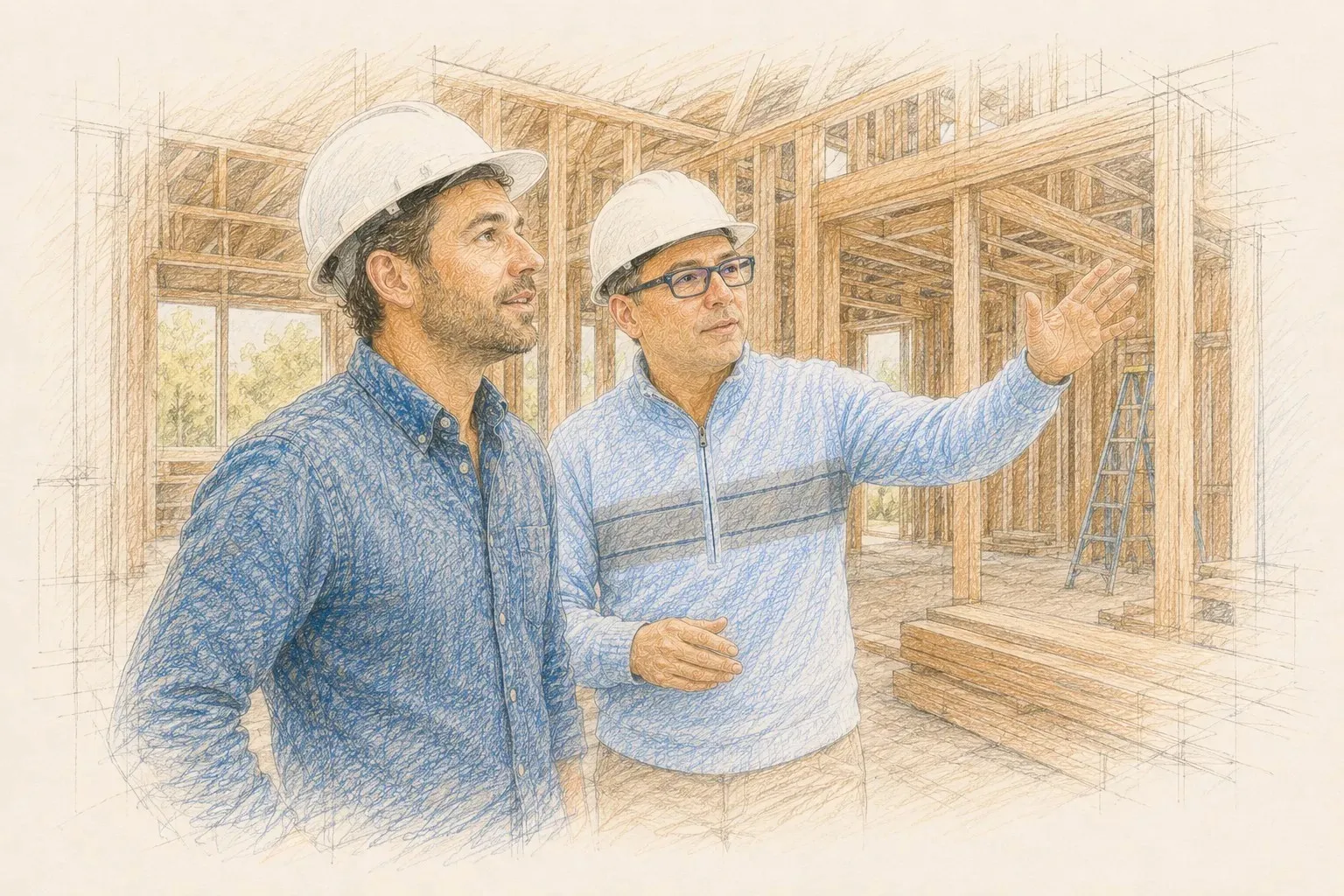
Quality craft, regular cleanup, and care for your property and neighborhood are how we run each job.
Franco Albarran, Founder

Construction starts before the job does
Pre-construction planning
Before the first subcontractor sets foot on your property, the person running the build has already walked the project end to end.
The budget is confirmed, drawings are final, and the schedule is mapped.
Materials with long lead times are ordered early.
Custom windows, tile, millwork: these can take months, and ordering them after the frame is up means the schedule waits for them.
The goal on day one of construction is to execute decisions already made, not to start making them.
Long-lead items are the most common source of construction delays on jobs managed by others.
Getting them right means tracking them from selection through delivery and building the schedule around their arrival date.
By the time framing begins, every selection that feeds into rough-in, electrical locations, plumbing rough, and blocking requirements has been confirmed.
The crew isn’t waiting on answers.
Thinking about how you’ll live in it
Some of the most consequential decisions in construction aren’t visible when the job is done.
Where a shower valve is placed determines whether you get wet reaching in to start it.
How a vanity wall is framed determines whether a mirror can go anywhere, or only where there happens to be a stud.
In the Georgetown primary shower, the valve was positioned on the entry side of the shower door, not below the showerhead.
You open the door, turn the water on, let it run warm, and step in dry.
The valve location was decided during framing, before anything was permanent.
The primary bath vanity walls at Sunset were sheathed in plywood from floor to ceiling before drywall closed.
No particular mirror size was confirmed yet, no final sconce selection made.
The plywood meant neither choice had to be locked in.
The mirror and sconces could land anywhere on the wall, at any height, without opening it back up.
These decisions are worked out during framing walkthroughs, when the structure is visible and nothing is fixed.
The person walking the site is the same person who designed the space.
What happens on the job site
One team, one point of accountability
There is no general contractor between you and the work.
The person who held the design intent through drawings, selections, and pre-construction is running the build.
When a subcontractor needs direction, the direction comes from someone who understands why the detail exists.
When a question comes up in the field, it doesn’t need to travel through layers to reach someone who can answer it.
Ian, who built a new home with the firm, put it plainly: Franco was present every step of the way, and always available to assist with any issues that came up.
Regular updates, no chasing
Construction moves in phases: foundation, framing, rough mechanical and electrical, insulation, drywall, finishes.
At each transition, you get an update: what just happened, what’s starting next, what selections are due and when.
The timing of your decisions is anticipated.
You’re not pulled in unexpectedly because something needs to be decided in the next 24 hours.
Andrew and Sarah described the process as being guided step-by-step, with regular updates regarding timing of work, inspections, and selections.
The project doesn’t accelerate past you.
How the site is kept
Daily cleanup and weekly resets are standard on every job.
Materials are organized, debris is cleared, and the site doesn’t spill past your property line.
Andrew and Sarah noted that multiple neighbors thanked Franco for being mindful of areas beyond their fence line.
This is how every job is run.
Judy, whose 1950s ranch house was transformed top to bottom, said he kept a close watch on the project and took time to address all her questions and concerns.
That attention doesn’t stop at the edge of the build.
When something unexpected happens
Problems get surfaced early
Every project has moments where something doesn’t go exactly as planned.
A wall opens and reveals something unforeseen.
A detail that worked on paper needs to be rethought in the field.
A material arrives wrong.
Organized construction doesn’t prevent these things.
What it determines is how quickly they’re resolved, who finds out, and whether you are part of the solution or informed after the fact.
When something changes, you hear about it before the crew moves on.
How small changes get resolved on site
The structure of a well-run project is what makes problem-solving fast.
When the tile for the Georgetown utility room arrived in two shades instead of one, Franco and the tile installer worked out a pattern on site, alternating light and dark, and sent a photo to the homeowner.
She fell in love with it.
That kind of resolution is only possible when the rest of the job is organized enough to absorb a change without cascading.
The schedule wasn’t in crisis.
The decision was made in a day.
What the end of construction looks like
Selections that are already in hand
By the time the project reaches finishes, the choices aren’t being made; they’re being installed.
Hardware, fixtures, tile, paint, lighting: all confirmed during design or pre-construction, with delivery coordinated to arrive when the phase starts.
The end of a project should feel like a planned conclusion.
For the Georgetown primary bedroom, the bed frame was brought to the site during construction, physically laid out in the space, so the wall sconces could be located at exactly the right height before anything was fastened to the wall.
The nightstand positions were set the same way.
When the room was finished, nothing needed to be moved.
Full-size mockups during construction take more time up front.
They prevent the kind of thing that’s impossible to fix at the end.
The walkthrough before keys
Before handover, you walk the finished home.
What was designed is checked against what was built.
Selections are verified.
The same person who held the design intent through every phase is walking it with you at the end.
Andrew and Sarah called it first-rate organization, attention to detail, and communication skills.
The walkthrough is where that becomes tangible: moving through a finished home that looks exactly like it was supposed to.
Meet the Founder, Franco Albarran
The Design-Build Difference
I lead both the design and the build of every project.
The details you care about stay intact from first drawing through the final coat of paint.
Tell me about your site and what you're trying to build, and we'll take it from there.