Client Guide
New Construction Costs vs. Renovation Costs
Why renovating an existing home usually costs more per square foot than building new, and when renovating is still the right choice.
Franco Albarran, Founder

Why renovation usually costs more
Renovation is usually more expensive than new construction
Most homeowners assume renovating is the cheaper path.
For the kind of substantial renovation that touches the structure, mechanicals, and finishes, that assumption usually doesn’t hold.
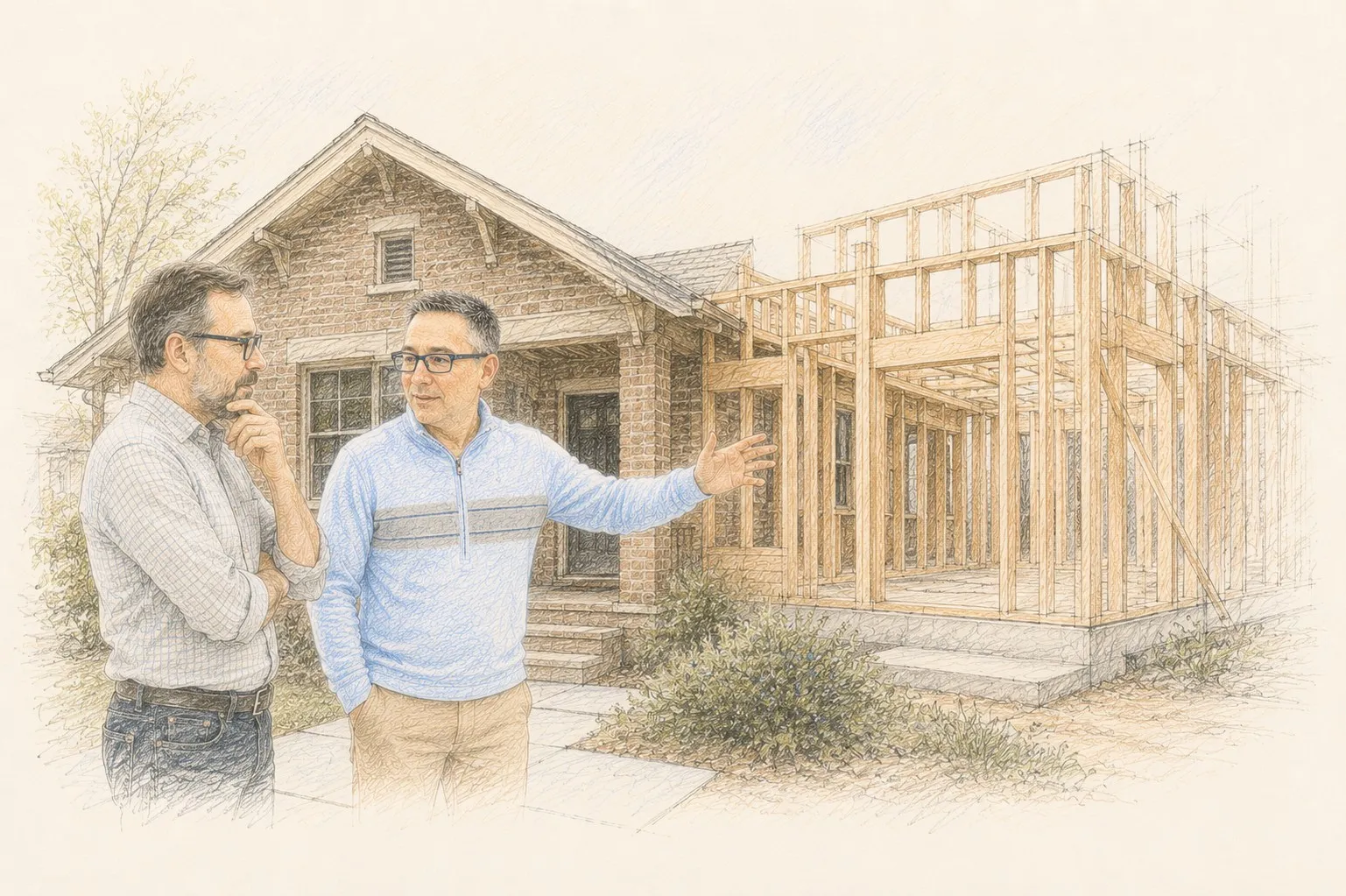
A typical renovation has three phases of construction where new construction has one.
In a renovation, the crew first deconstructs the existing conditions, then cleans up and sets up the site for new work, then installs the new construction.
A new build, after demolition, goes straight to building.
Two of those three phases exist only because something was already there.
You are paying for the work it takes to remove it, protect what stays, and prepare the site before a single new wall goes up.
Where the extra cost shows up
The three phases in practice
Deconstruction is slower than demolition on a raw site.
Existing framing, plumbing, electrical, and finishes have to come out without damaging what is staying, which rules out the faster methods a new build allows.
Cleanup and setup is the work between old and new.
Debris removal, dust containment, temporary protection for floors and adjacent rooms, and staging around a house that is often still occupied all take time and labor that a new build doesn’t carry.
Installation then has to match into existing conditions instead of building to fresh drawings.
A new floor has to meet an old one, a new wall has to align with framing that isn’t square, and an addition has to tie into a roof that was built decades ago.
What you find behind the walls
Renovations regularly uncover conditions that weren’t visible at the start: outdated wiring, unpermitted prior work, water damage, framing that doesn’t meet current code.
These are real costs that a new build doesn’t carry, and they are the main reason a renovation contingency should run higher than a new construction contingency.
On a new build, a 5% contingency is usually enough.
On a renovation, plan closer to 10%.
See How to Properly Develop a Construction Budget for how that contingency fits into the budget.
When renovating is still the right call
The reasons that outweigh the cost
Cost per square foot is one input, not the decision.
You renovate when the house or the site is worth more to you than the savings of building new.
That can be attachment to the home itself, a location you can’t replace, or trees and a setting that took decades to grow in.
It can also be zoning or setback rules that would prevent rebuilding at the same footprint.
In neighborhoods like West University Place, the existing house was often built before current setbacks took effect, and tearing down means the new house has to meet today’s rules.
That can give you a smaller or differently shaped home than the one you have now, which makes renovating the only way to keep the footprint you already live in.
Timeline can push the other direction too.
A full new build usually takes longer than a targeted renovation, and if you are living in the house or need to be in by a certain date, that matters.
Judy inherited her parents’ 1950s ranch and worked with Franco to renovate it top to bottom.
Ian designed and built a new home from the ground up.
Both were the right call for the homeowner in front of us.
Cost per square foot tells you what each path costs, not which one is right for you.
The decision comes down to which path fits your house, your site, and what you want to end up with.
Frequently asked questions
Is renovating cheaper than building new?
For light renovations that don’t touch the structure or systems, often yes. For substantial renovations that involve framing changes, mechanicals, and full finishes, usually no. Renovation labor runs higher per square foot because deconstruction, protection of existing conditions, and tying new work into old all take time that a new build doesn’t carry.
How much more contingency does a renovation need?
A new build with clean drawings can usually budget a 5% contingency. A renovation should plan closer to 10%, sometimes more on older homes. The extra cushion covers conditions that aren’t visible until walls open: outdated wiring, unpermitted prior work, water damage, framing that doesn’t meet current code.
Why is labor so much more expensive on a renovation?
A new build’s framing crew can move quickly through a clean site. A renovation crew works around an existing structure that often needs to stay standing during the work, ties new framing to old, and protects floors, finishes, and adjacent rooms. The same scope of work takes longer because the path through it is constrained.
When is renovating still the right choice?
When the house, the trees, the location, or the existing footprint is worth more than the savings of building new. In neighborhoods like West University Place, current setback rules can mean a teardown produces a smaller footprint than the existing home, which makes renovating the only way to keep the size you have. Timing can push the same direction: a targeted renovation often runs shorter than a full new build.
Meet the Founder, Franco Albarran
The Design-Build Difference
I lead both the design and the build of every project.
The details you care about stay intact from first drawing through the final coat of paint.
Tell me about your site and what you're trying to build, and we'll take it from there.